

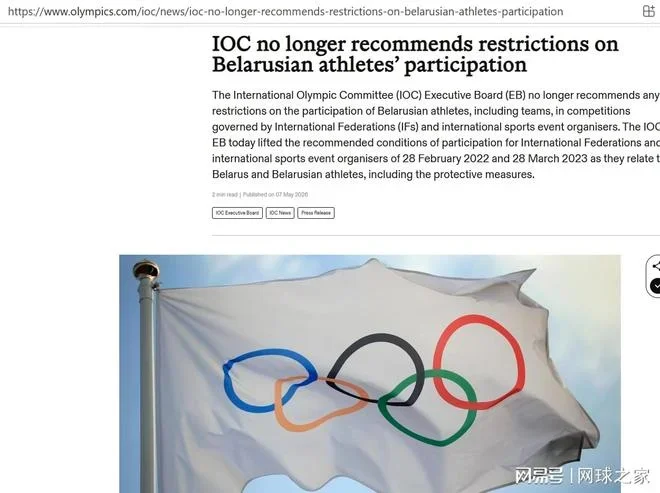
On May 7, the International Olympic Committee (IOC) Executive Board officially announced the full lifting of restrictions on Belarusian athletes, revoking the constraints imposed in 2022 and 2023. From now on, Belarusian competitors and teams can participate in all events under the IOC framework without the need to compete as neutral athletes.
This decision marks a significant turning point in a four-year saga where sports and politics intertwined. It also brings hope to world No. 1 tennis player Aryna Sabalenka, who dreams of representing her country under the Belarusian flag at the 2028 Los Angeles Olympics.
The restrictions were originally imposed in 2022 following the outbreak of the war in Ukraine, as the international community widely believed that Belarus had assisted Russia in its invasion. In 2023, the policy was adjusted to allow neutral participation, meaning Belarusian athletes competed without flags, anthems, or national identifiers at events such as the Paris Olympics and the Milan Winter Olympics, completing their campaigns smoothly.
The IOC emphasized in its May 7 statement that athletes should not be stripped of their right to compete due to the actions of their governments. This principle was reaffirmed during the Executive Board meeting in September 2025 and the Olympic Summit in December of the same year. With qualification for the 2028 Los Angeles Olympics and the Winter Youth Olympics beginning this summer, the timely lift of the ban clears the path for Belarusian athletes to pursue Olympic glory.
However, the IOC’s decision applies only to Belarus. The Russian Olympic Committee remains suspended, and the World Anti-Doping Agency is still investigating Russia’s anti-doping system. The IOC stated that further evaluation is needed, and there is currently no timeline for lifting restrictions on Russian athletes.
Among the athletes most affected by the policy change is Aryna Sabalenka, the Belarusian tennis star and world No. 1. Since 2022, she has competed under a neutral status in tour events and Grand Slams, with her national identity concealed.
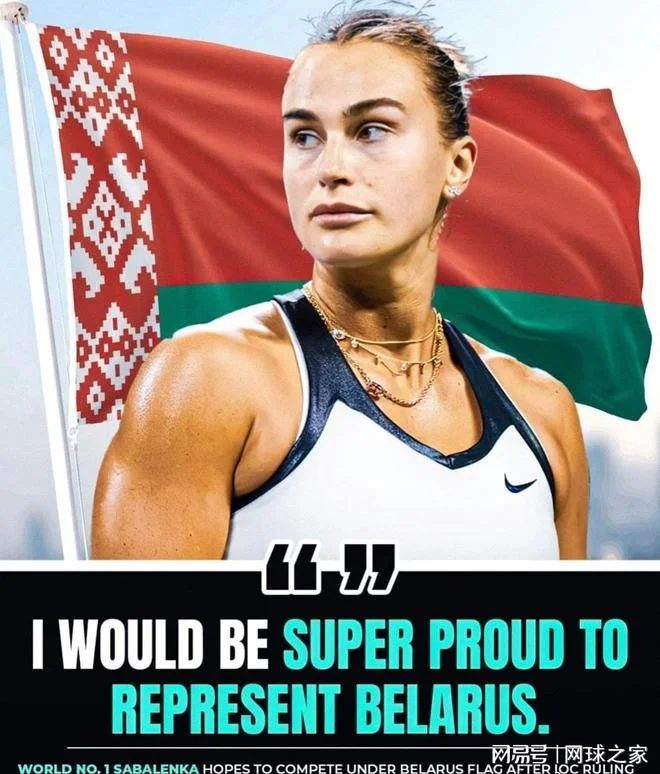
On the day of the IOC’s announcement, following her first-round victory at the Rome Open, Sabalenka expressed her feelings openly: “I really hope they can give our flag back to us. I know that I’m a huge inspiration for the young generation in Belarus. Kids always send me messages, and I want them to be confident—no matter where you come from, you can reach the top.”
For Sabalenka, the flag is not just a piece of cloth; it represents national pride and personal identity. She emphasized that representing Belarus at the highest level of tennis is meaningful, and she dreams of competing in the Olympics as a true national team member. Under the new rules, she is eligible to represent Belarus and wear the national flag at the 2028 Los Angeles Olympics.
Nevertheless, the IOC’s decision does not automatically translate into changes across the entire sports world. On May 8, the International Tennis Federation (ITF) made it clear that the IOC’s decision would not alter the tennis community’s sanctions. The bans on the Belarusian and Russian tennis associations remain in effect, meaning events like the Davis Cup and the Billie Jean King Cup will continue to exclude both countries. The ITF also stated that the membership status of the Belarusian Tennis Association will be reviewed at the annual general meeting in October, with no immediate relaxation expected.
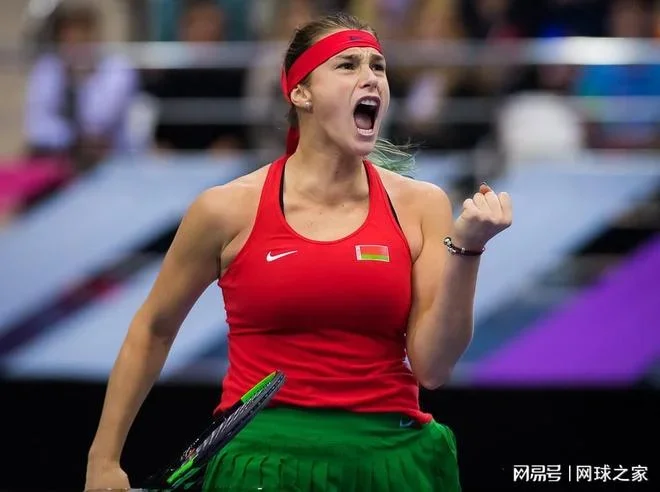
This means Sabalenka’s hope of competing under the Belarusian flag in tour events and the four Grand Slams remains unfulfilled for now. The WTA, ATP, and the four Grand Slam tournaments are still enforcing neutral participation rules. In the short term, players from Belarus and Russia must continue competing as neutral athletes in tournaments such as the French Open.
Sabalenka previously participated in the women’s singles tennis event at the 2021 Tokyo Olympics, where she lost in the second round to Donna Vekić. Now, four years later, the path from a full ban to a limited return for Belarusian athletes reveals the complex tug-of-war between sports and politics. The IOC is striving to protect the purity of competition from political interference, while individual federations like the ITF are proceeding cautiously, based on their own positions and public sentiment.
For Sabalenka, the IOC’s decision is a ray of hope but not the finish line. She may fulfill her dream of wearing the national flag at the Los Angeles Olympics, but she still has to wait in professional tennis. In the coming months, the ITF annual general meeting vote and whether the WTA and ATP will shift their stance will determine when this world No. 1 can truly “play for her country.”
Sports should not be a casualty of politics, but reality often involves compromises and tensions. After a series of twists, Belarusian athletes are gradually returning to the international stage, while Sabalenka’s hopes on the tennis court remain a work in progress. The hope is that sports and politics can be disentangled, and that athletes’ sweat and effort should be defined by trophies and applause.
