

At the 2026 World Snooker Championship final, Chinese player Wu Yize defeated England’s Shaun Murphy 18-17 to claim the title. Wu became the first post-2000s world champion in snooker history and the second Chinese player, after Zhao Xintong, to win the sport’s most prestigious event. Once again, a Chinese snooker player has etched a new chapter in the sport’s history.
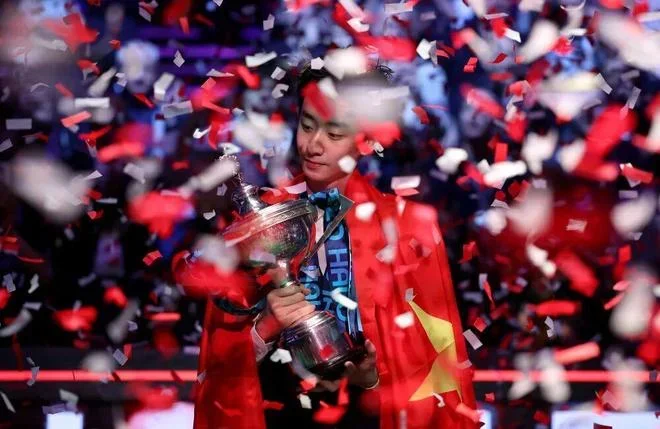
Wu Yize looks at the championship trophy. Xinhua reporter Li Ying
Wu possesses an extraordinary “big heart.” He swept Lei Peifan 10-2, then fought back from 14-16 down to overturn Mark Allen with three consecutive frames, and sealed the tense final with a single winning break in the deciding frame. His composure beyond his years was the key to navigating through a field of world-class competitors.
When defending champion Zhao Xintong was eliminated by Murphy in 2025, Wu found another way to fulfill the dream for Chinese snooker. Wu studied at Ding Junhui’s Snooker Academy in his youth. After the match, Ding Junhui emotionally declared: “From Zhao Xintong to Wu Yize, Chinese players have stood at the top of the World Championship for two consecutive years. This is not just a breakthrough—our era is arriving.” Zhao Xintong had earlier said the sport would eventually belong to China.
Now, few doubt that claim. Wu’s meteoric rise reflects the rapid development of Chinese snooker. World champion Ken Doherty once noted, “China has about 300,000 snooker halls—on Tuesdays, you might struggle to book a table.” This solid grassroots foundation has fueled the progress of Chinese players. In 2025, 10 Chinese players qualified for the World Championship main draw, with six reaching the last 16. In 2026, 11 Chinese players qualified, and four reached the last 16.
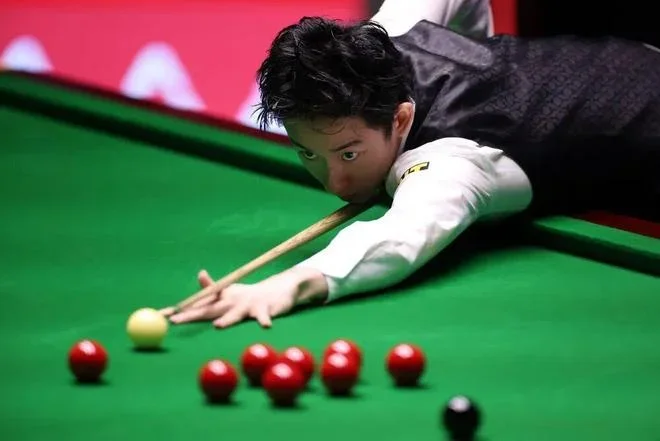
Wu Yize in action. Xinhua reporter Li Ying
Why have Chinese snooker players suddenly become so strong? This is no coincidence. Behind every “snooker prodigy” stands a family as a steadfast support. Wu Yize said his parents are the true backbone: “They are the real champions. From the moment I dropped out of school as a child, my father never left my side, always accompanying me.” Zhao Xintong echoed similar words after his championship.
“Thanking parents” is both a gesture of gratitude and a key to understanding the recent surge in Chinese snooker success: families’ relentless investment, day-and-night companionship, and encouragement create a nurturing environment. In Wu’s case, his father closed his stable antique shop to accompany him full-time and even sold their only home. More importantly, parents recognized and cultivated their child’s talent.
Snooker is a lonely, demanding sport, full of unseen hardships. It tests not just the player but the entire family’s long-term commitment. Without extraordinary endurance and confidence, no one could persevere.
The successes of Zhao Xintong and Wu Yize offer inspiration for young players aspiring to professional snooker: individual passion and talent, combined with parental support and tolerance, are indispensable. Competing in major snooker events also brings glory to the nation. The cultivation of young snooker talents deserves more support from families, policies, and institutional frameworks. In other words, we can open more options in the Chinese snooker talent development model, allowing more “prodigies” to emerge.
